
Our LMS solution
A new era for learning at your workplace
Digital learning transformation emcompasses cultivating both the right mindset and resources in order to support your people during the transition.
The PwC’s Academy Learning Management services distincts in providing a robust and fully-administered learning platform that can help you deliver quality learning experiences while helping your people increase their digital fluency.
Learning management support services
The learning management support services can set you up to start transforming the learning culture by using a platform where all learning content, resources, and reporting is centralised. This enables the people to increase time in learning and decrease time doing manual administration.
To ensure the best user experience, we employed a web-based learning management system called Moodle. The PwC’s Academy Moodle LMS operates in a secured platform designed to meet the highest level of trust, transparency, standards conformance, and regulatory compliance including our Global compliance assessment process.
This learning management system is highly customisable and can support the full range of learning and development life cycle from user administration to course management and development.
With our learning management support services, you can transform the way you do your learning.
Transforming the way you provide learning

Level-up the learning experience by building highly interactive and engaging content within the learning management system.

Increase learning engagement with a badging system and guide your learners with use of learning plans.

Reduce manual attendance recording through integrated virtual learning conferencing tools and attendance activity.

Help your HR team monitor the competencies by using the competency framework linked to the training programs completed.
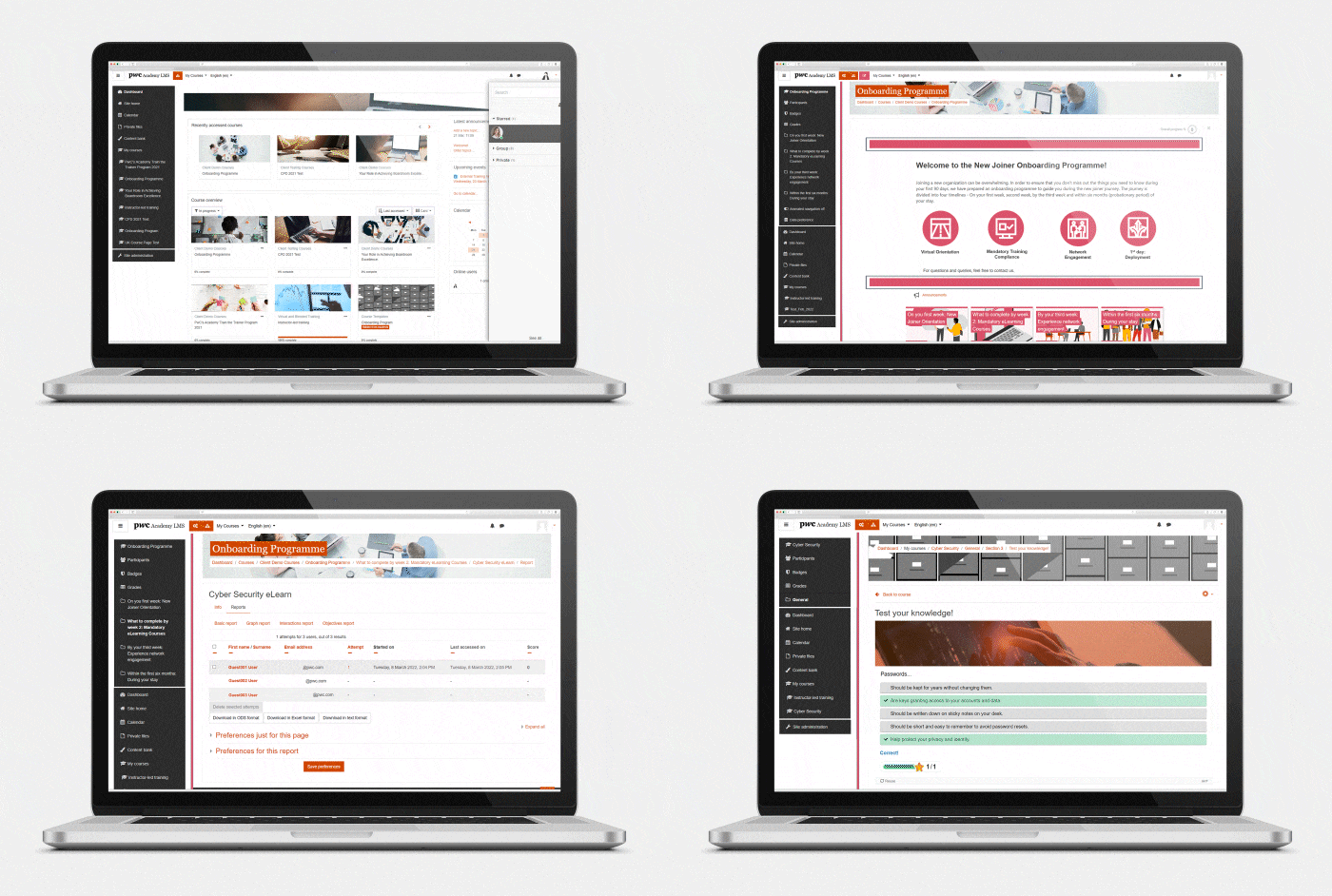
Reimagine the way you do learning
Everywhere, even globally, companies are finding ways to better support their people in their upskilling journey. While upskilling journeys may differ from one company to another they all have the same goal – to ensure that the people of the organisation have the right skills in order to achieve the business goals.
Using the learning management system you can have more time for analysing the data by automating repetitive tasks such as notifications and messaging, badges, and custom certificates.
Other programs such as onboarding and compliance training can be designed to help users track their own progress.
Case study 1: Moodle LMS and e-learning courses on compliance, cyber security, insurance concepts and its systems – multinational insurance company
What was the situation?
The client, an international insurance company with offices set up in Malta came to PwC’s Academy to digitise their learning set-up. They were legally required to report to the regulator about the training activity. The learning requirement required CPD training reach out to all employees and tied insurance intermediaries on an ongoing basis and with timely reporting to the regulator.
What was our solution?
We partnered up with different subject matter experts from the client’s risk office, human resourcesoffice and the different business offices to design and develop a LMS using Moodle and containingmultiple learning modules.
Each module was designed as an individual eLearn or as a collection of eLearns that the learnersneeded to do subsequently.
With a duration between 30 and 90 minutes, all e-learning courses consist of different chapters andintermediate level of interactions, including a mix between reading material, videos and interactiveparts such as quizzes, use cases, reflection questions and final assessments.
What were the benefits/outcomes?
The client is able to view and download the monthly progress reports of their courses on Moodle(F2F, eLearnings, Hybrid), and reports management.
Designed and delivered around 20 eLearning courses covering the following topics: Ethics &Insurance; Anti-Money Laundering; Basics of Investing & Financial Risks; Life Insurance Policy; CRM sales system (collection of 8 eLearns modules); Sapiens Point of Sale; Insurance Principles,Beneficiaries, Terms and Benefits; General Data Protection Regulation & Information Security.
Case study 2: Moodle LMS, Onboarding programme, and e-learning courses on health and safety, cyber security, and GDPR – fast-moving consumer goods (FMCG) company
What was the situation?
The client, a distribution and marketing company in Malta requested for support in digitising their mandatory learning programs. The goal of the digitisation project was to centralise the compliance reporting, increase learning distribution efficiency and provide a better learning experience to their employees.
What was our solution?
Our team divided the solution into two milestones. 1) eLearning Course development for Mandatory Courses and 2) Implementation of LMS System which covered the Onboarding Program Digitisation.The first milestone was a project together with the client’s SMEs in building the course content and ensuring effective learning solution. The second was a project with the HR Administrator in identifying onboarding journeys of different departments within the company and providing their employees with a centralised Learning hub they can also refer to for checklists, compliance, policies and procedures for each timeline (1st day, 1st week, 1st Month, 3rd month and 6th month).
What were the benefits/outcomes?
With the use of the LMS, the client only need to provide their employees access to the courses andthe system identifies what is applicable to these employees based on their department and only showthose. This is a very efficient and sustainable way of providing mandatory courses in a big company.
Embedded assessments provide automatic grading and compliance reporting. Through the digitised Onboarding Program, employees can easily access these mandatory courses and view all the pending checklist/tasks they need to complete during their probationary period.
Case study 3: Moodle LMS and development of programme for security operations centre analysts – A Maltese government agency
What was the situation?
The client, a Maltese government agency under the Ministry of Finance and Financial Services,requested a full on Learning Management System services and development of training program for SOC Analysts. This programme is offered publicly and is intended to run seven (7) times from 2023till 2025 with 3 delivery stages – pre-assessment, foundational courses and summative assessment,and advanced course and summative assessments. Additionally, the client has requested training coordination support for data report for each run and consolidation for each round (all of 3 stages).
What was our solution?
We partnered up with our subject matter experts from the cyber security team and with a well-known ICT training provider in Malta to develop the learning content of the program. Within PwC Academy our team then design and develop the training material within the Moodle LMS for the learners to interact and complete.
Each course has several modules and checkpoints with the final assessment and feedback form that is required to be completed before receiving the training certificate. This helped manage the program efficiently and effectively and to ensure the program is of quality.
What were the benefits/outcomes?
The client is able to provide the training courses seamlessly to the learners and the facilitators haveaccess to the platform to directly support the learners for any inquiries and to check any progress,grades and feedback reports. This helped the client to get timely report and for us provider to haveactionable items to improve for the next run without time delay.
Assessments are automatically graded. Upon completion of the assessment and the feedback form,learners are able to download the certificate of completion.
Still not sure?
Do you have a question you would like to ask our specialists?